



–
▷〒906-0000 沖縄県宮古島市平良西里147 / MAP
▷WEBSITE :
▷SOCIAL :居酒屋すく
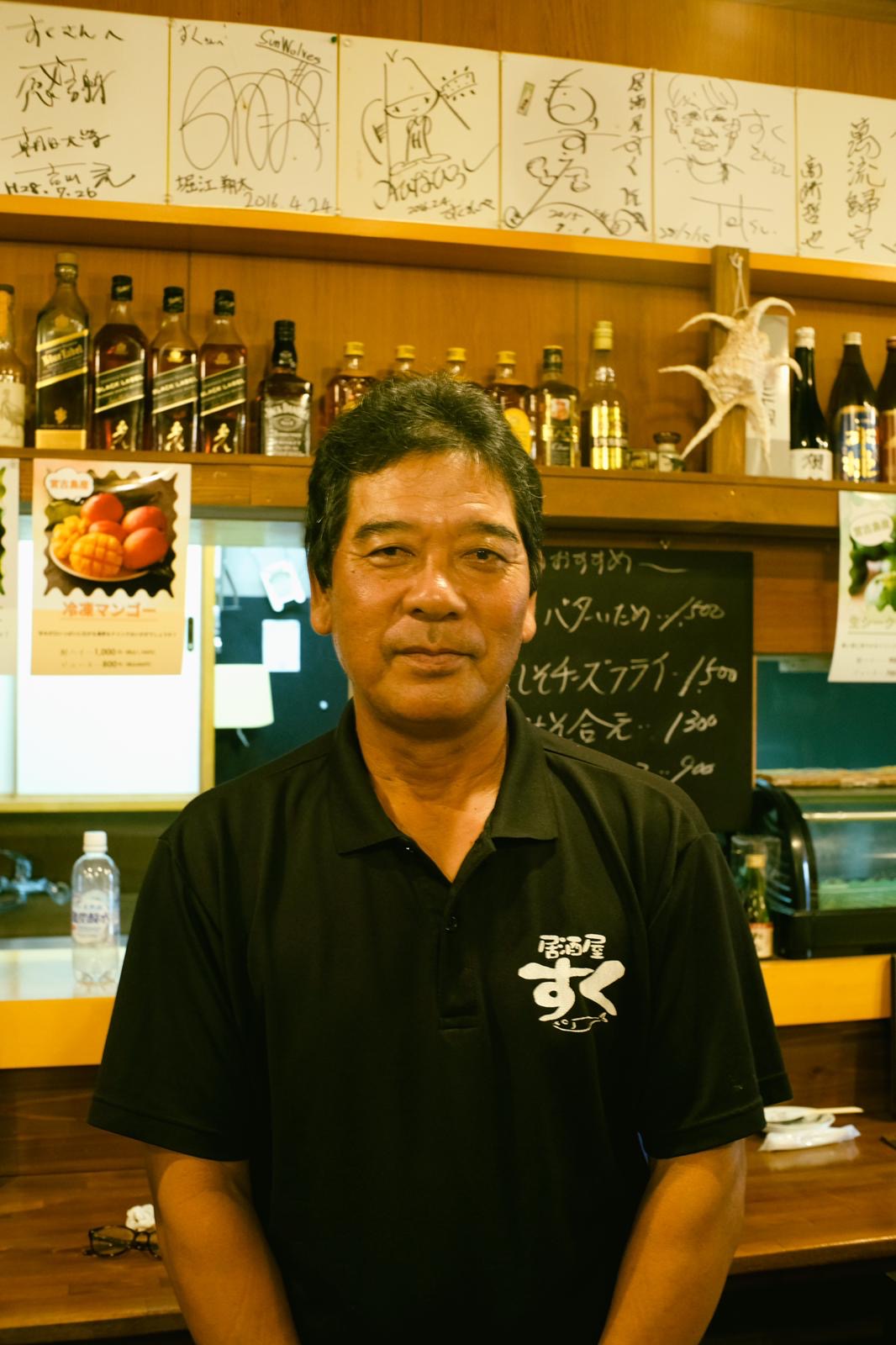
【 すく | 平田実 】
「素材の持ち味を活かすシンプルな料理の方が得意」
居酒屋「すく」のメニューは、どれを選んでもすべてが美味しい。
つい頼んでしまう黒板メニューは、店主の直筆によるものだ。
古宇利島出身の店主・平田実さんは、幼少期から自然に囲まれて育った。
部活そっちのけで漁の手伝いに励み、半農半漁の家業を10人兄弟の末っ子ながら支えてきたという。
その生活のなかで、自然と寄り添う感覚が身体に刻まれた。
毎朝の日課である花への水やりも、「たっぷりとかけてあげること」が大切だと話す。
素材や食材への愛情も同じで、惜しみなく手をかけることを忘れない。
DNAレベルで染みついた素材への向き合い方はシンプル。
便利な機械や調理器具を用いず、何十年と手に馴染んだ道具で丁寧にお料理する。
子ども時代から料理が大好きで、20代の頃に那覇の割烹で修業を積み厳しい手ほどきを受けた。
「創作料理よりも、素材の持ち味を活かすシンプルな料理の方が得意」と、穏やかに振り返る。
宮古島に移り住んだ当初は、城辺・福里でお弁当・惣菜のお店を立ち上げた。
朝から晩まで働きづめの日々の中、地元の人々からはオードブルやお酒のつまみの注文が絶えなかった。
10年を経て、2015年に平良の地で「すく」を創業。
今年で節目の10周年を迎えた。
常に料理の仕込みを怠らず、入念な準備を当たり前にこなす。
その姿勢が「すく」の味を支えている。
店名の「すく」は、妻・えつこさんの実家の屋号に由来する。
また、沖縄の郷土料理“スクガラス”(アイゴの稚魚)や、宮古の言葉で“底”を意味する言葉としても親しまれている。
「“すく”という重たい名前は自分に責任感を持たすため、絶やさないように」と語る。
その名の通り、底から湧き上がるような”すく”の底力はまだまだ計り知れない。
–
Questionnaire
朝は早起きですか?
> 5時起き
アラームなしで起床する。
20年前の伊良部の橋がかかる以前から現地の漁師と仲良しで魚を捌いていた習慣が身についた。
半農半漁の家系で育ち、部活よりも漁を優先していた子ども時代。
好きな飲み物は?
> ヨーゴやネクター
甘いドリンクが好き。
亡くなった父も海に行くときによく持って行ってた。
好きな色は?
> 青
海が好きだから。・
学生時代の得意科目は?
> 数学
買い出しや仕入れに行くと頭の中で常に計算している。
何度も繰り返し見た映画は?
> 「ランボー」/ 1982年 アメリカ
アクション物は繰り返し見ます。
本棚で1冊選ぶなら
> 料理本
本はあまり読まないが、あえて言うなら。
好きな場所はどこですか?
> 漁港
ぼーっとする場所。
いつも聴いている音は?
> テレビの音
無音だと落ち着かない。無意識だけど情報を取り入れているのかもしれない。
いつも身につけているものは?
> –
毎日のルーティンはありますか?
> 花の水やり
お花が大好き。
この時期(10月)はブーゲンビリアがきれいに咲く。
最近の調べものは?
> –
アイデアを創出するための方法はありますか?
> 素材そのものの持ち味をよく理解しているので、組み合わせは自分の感覚を信じる。
そのアイデアを出力する方法はなんですか?
> 食材の良さをわかっているからこそ、仕込みを怠らなければ料理ができる。
日々の健康のために何か取り組んでいることはありますか?
> ゴルフ
ピッチ上で歩くことを意識している。
時間があればゴルフレンジに行く。
仕事をする上で大切にしていることはありますか?
> 料理の仕込みを怠らず、入念な準備を当たり前にこなす。
いま会いたい人/尊敬する人はいますか?
> ウエダさん
20代で修行に励んだ勤め先の割烹料理屋の大将。

▷ADDRESS : 531-3 Hirara Shimozato, Miyakojima City, Okinawa 906-0013, Japan / MAP
▷WEBSITE : –
▷SOCIAL : Izakaya Suku
【 Suku | Minoru Hirata 】
“Simple Dishes That Bring Out the True Flavor of the Ingredients”
At Izakaya Suku, every item on the menu is delicious — no matter what you choose.
The handwritten chalkboard specials, written daily by the owner himself, are especially hard to resist.
Born and raised on Kouri Island, owner Minoru Hirata grew up surrounded by nature.
As the youngest of ten siblings in a semi-agricultural, semi-fishing family, he spent his youth helping with the day’s catch instead of attending club activities.
Through that way of life, a deep, instinctive connection with nature took root within him.
Every morning, he tends to his flowers — a quiet ritual he never skips.
“You have to water them generously,” he says.
The same philosophy applies to cooking: treat the ingredients with love, and never hold back on the care they deserve.
His approach to food is deeply ingrained — almost at the level of DNA.
He avoids modern machines and electric appliances, preferring instead the simple tools that have fit naturally in his hands for decades.
Cooking has been a passion since childhood.
In his twenties, Hirata trained rigorously at a kappō restaurant in Naha, where he honed his technique under strict guidance.
“I’m better at simple dishes that let the ingredients speak for themselves,” he says with a calm smile, “rather than at overly elaborate creations.”
After moving to Miyakojima, he first opened a small bento and deli shop in Fukuzato, Gusukube.
He worked tirelessly from morning till night, and soon gained loyal local customers who would often order party platters or side dishes to pair with drinks.
A decade later, in 2015, he opened Suku in Hirara.
This year marks the shop’s 10th anniversary — a milestone built on years of quiet dedication and consistency.
Hirata never cuts corners in his kitchen.
He’s meticulous with preparation and ingredients, always ensuring that the foundation of each dish is solid.
That unwavering attention is what gives Suku its distinct, comforting flavor.
The name “Suku” carries multiple layers of meaning.
It comes from the house name of his wife Etsuko’s family, but it also recalls “sukugarasu,” a traditional Okinawan delicacy made from juvenile rabbitfish preserved in salt, and in the Miyako dialect, “suku” means “bottom” — the base, the depth.
“It’s a heavy name,” Hirata admits. “I chose it to remind myself of responsibility — to never let it fade away.”
True to its name, the strength that rises quietly from the bottom — Suku’s depth — continues to grow, unseen yet unmistakable.
–
Questionnaire
Do you usually wake up early in the morning?
> I wake up at 5 a.m., without an alarm.
Even before the Irabu Bridge was built — more than twenty years ago — I used to visit fishermen on the island to help prepare their catch.
That habit of handling fish early in the morning has stayed with me ever since.
I grew up in a semi-agricultural, semi-fishing family, and as a child, I often chose fishing over school club activities.
What’s your favorite drink?
> Yogo and Nectar.t coffee.
I have a sweet tooth when it comes to drinks.
My late father used to take the same drinks with him whenever he went out to sea.
What color do you often use?
> Blue
Because I love the ocean.
Your favorite subject in school?
> Math.
Even now, when I go shopping or to the market for supplies, I’m always doing mental calculations.
Is there a movie you’ve watched over and over again?
> Rambo (1982, USA).
I tend to rewatch a lot of action movies.
If you could pick one book from your bookshelf, which would it be?
> A cookbook
though I don’t read much, that’s what I’d choose.
Where is your favorite place?
> The fishing port.
It’s where I go to clear my mind — just to sit and stare at the water.
A sound you often listen to?
> The sound of the television.
Silence makes me uneasy, so I keep it on.
Maybe I’m unconsciously picking up bits of information while I work.
What do you always carry with you?
> –
Do you have any daily routines?
> I love plants
Around this time of year (October), the bougainvillea are in full bloom.
What’s a word or concept you recently looked up?
> –
Do you have a method for generating ideas?
> By trusting my senses.
I understand the character of each ingredient, so I rely on intuition when combining them.
How do you usually express or output those ideas?
> As long as I prepare carefully and never skip the groundwork, the cooking naturally follows.
Is there anything you do regularly to stay health?
> Golf.
I try to stay active by walking across the course, and when I have time, I go to the driving range.
What do you value most in your work?
> Never skipping preparation — being thorough and consistent every day.
That mindset is what sustains the quality of my cooking.
Is there someone you’d like to meet?
> Ueda-san,
The head chef of the kappō restaurant where I trained in my twenties.

 dodo meguri